






When CEO and Co-Founder of AI technology company CloudNC, Theo Saville, first graduated from studying Mechanical Engineering at the University of Warwick, he was drawn to the pace of change and breakneck speed of additive manufacturing technology.
“I’m a manufacturing, mechanical and robotics engineer by background, and I love making stuff. I’ve been making stuff pretty much as early as I could hold a screwdriver,” Theo told Machinery. “At University, I was used to working with 3D printers, making stuff out of plastic – essentially becoming a one-man manufacturing army.
“But as soon as I started working on projects that required a very large number of very complicated metal components, the parts can’t come out of the printer anymore. Rather than getting components in 24 hours, I was being quoted ten weeks, which struck me as completely insane.
“I found myself standing in front of a CNC machine asking, ‘why can’t I just press a button and get parts out of this? Sure, it's complicated, but it can’t be that complicated, can it?’”
Despite being told that yes, the idea was actually very complicated, Theo set out to make CNC machining much faster, simpler and more accessible, realising the disruptive potential if the process could be automated to the same degree as plastics 3D printing.
After meeting his Co-Founder and CloudNC’s Chief Scientist Chris Emery at Entrepreneur First – a UK incubator that matches founders together – who also had prior experience of working at an additive manufacturing start-up, the two began talking directly to manufacturers, raised seed capital from family and friends, and established a pitch for their new company.
“I reread our seed investor deck last year, which we originally wrote ten years ago, but it reads like we wrote it just yesterday. Our mission hasn’t changed. We want CNC users to be able to click a few buttons – not 600 – and type a couple of commands to machine a component. We want a relatively inexperienced operator to be able to get this result, not just those with ten years of experience.”
While simultaneously finding a facility, growing their investment funding and establishing a team of engineers to work alongside them, Theo and Chris began developing the automated, AI-driven software set to change the machining game.
Despite knowing from the outset that achieving the mission was no easy feat, some fundamental issues kept repeatedly coming up: namely, that there was an infinite combination of solutions that could be used to automate precision manufacturing, and that the physical environment of machining that the software had to handle was incredibly challenging.
As such, the team had to build up a huge codebase of knowledge to solve all the disparate parts of the problem, and development took years. The company’s progress never faltered, though, with it even building its own factory full of production machines to not only test the software on, but to also produce parts for the industry.
Introducing CAM Assist
In July, 2023 – eight years after the company’s foundation – CAM Assist was launched: an AI-powered tool that can analyse a 3D CAD model to automatically generate a complete CNC machining strategy.
Users can upload a 3D CAD model of their part into their chosen CAM software, where CAM Assist is integrated into, and define their given parameters – such as the available tools, materials, workholding and accurate machine specifications.
The system's AI and computational geometry algorithms analyse the entire modelled part, measuring and mapping its features to understand the most efficient way to machine it.
As such, the software generates a machining plan in its entirety, including toolpaths, cutting directions and optimal speeds. The user has the ability to review the AI’s chosen strategy, making any edits or adjustments if they see fit.
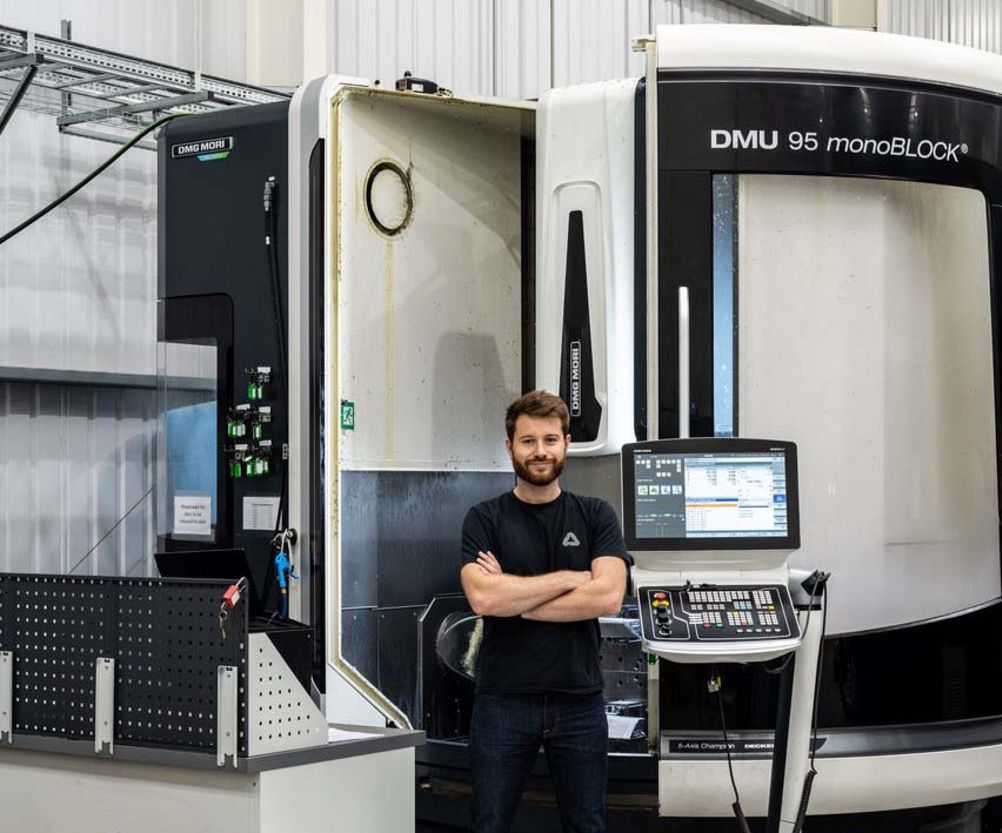
Once approved, the machining plan is translated from the CAM software as a G-code to the CNC machine – completing 80 per cent of the CAM program in just minutes, a fraction of the time it would have taken an operator alone.
“Our customers can get more throughput from their machines, more throughput from their people means that they can deliver parts faster. They can respond to quotes faster, get parts out the door faster, and ultimately make more money,” Theo said. “There are also little human factors – I’ve had people say that they can now go home and eat dinner with their kids, thanks to the time saved.
“When I speak to customers, their problems always come down to the fact that they can’t hire CAD/CAM programmers, so the only answer is to get more productivity from the ones that they already have.
“You still need skilled programmers to polish the software’s strategy, but they’re no longer doing boring, incredibly basic math in order to actually get something onto the machine. They’re now in higher value work, they’re much more productive, which means getting much more out of the same people to build a better, more successful business.”
And CloudNC is only improving its offering. In September of this year, it launched CAM Assist 2.0, a major upgrade to its AI solution that further accelerates the CAM programming journey from CAD model to machine‑ready toolpaths.
The latest model retains the speed of CAM Assist while adding the oversight, feedback and shared intelligence elements that machine shops need in order to use AI with confidence.
It now lets users see and ultimately influence the AI’s decisions as they happen in real-time, while also running on its own web-based CAM automation application that initiates from the user’s CAM package. As with the original CAM Assist, both 3-axis and 3+2 operations are supported.
In the new web UI, the user still generates a working toolpath by pressing the CAM Assist button, as with the original model, but now 2.0 breaks out the AI stages so that parts can be assessed prior to running. As files are being computed, control over strategy editing is passed to the user, too.
CAM Assist 2.0 is available to all customers across Autodesk Fusion, Mastercam and Siemens NX platforms, with further integrations expected to be announced soon, the company said.
As for the industry response to the technology, Theo says: “It feels to many people like something that should have always existed, so that makes for a positive response. I’m pleased with the way people have responded to it online as well – we get quite a lot of gratitude.
“I think it helps that we’re seen as being part of the industry, because we make the metal parts, we have a factory, we’re not building software having no idea what’s needed. We know a lot about the business of machinery from having run machinery businesses.”
As of this year, CAM Assist is now being used by over 1,000 machine shops and machinists worldwide, across a whole host of sectors – in the aerospace and defence industries, for instance, though Theo emphasises that CloudNC’s software is useful for any company and industry that needs metal components.
Interestingly, a lot of the company’s current clients are out in the US, with it targeting overseas manufacturers not only for their technological innovation, but for their willingness to take a chance on something new.
The technology itself is beyond impressive, with it offering manufacturers a means to revolutionise their CNC machining. It’s clear that Theo and his team truly believe in the not so simple mission to make machining more efficient and accessible, and certainly show no signs of slowing down despite their recent breakthroughs and successes.
“We’ve faced enormous challenges getting to where we are – nine years of impossible technology, trying to raise money in order to keep going and not die as a business. Our biggest challenge now is entering new markets, and building the next, extremely large iterations of the technology,” Theo adds.
“I’d like to believe that in five years’ time, say, people won’t be doing very basic CAM anymore. I’d like to think that they’re going to be putting out four or five times more components per employee, per CAD programme. I would hope we’d be supporting much more complicated machine types as well, helping to produce larger, more complex parts. If that’s happening, then I’d consider us to be nearing mission accomplished territory – though this is only the beginning.”


